
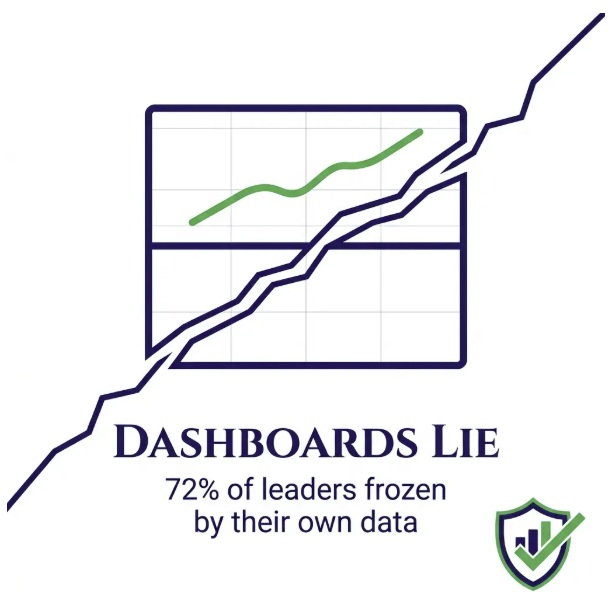
Why Financial Dashboards Often Mislead Management
I watched a client nearly destroy their business while staring at a dashboard that told them everything was fine.
They had just turned profitable. The numbers looked good. Revenue was climbing. They decided it was time to build, to expand, to take the next step. Within months, they ran into cash flow problems they could not fix. The bank refused additional loans because of their history of poor financial management.
The dashboard showed profit. It did not show the cash flow reality about to crush them.
This is not a story about bad data. This is a story about what happens when business owners confuse information with understanding. The dashboard gave them numbers. It did not give them sight lines into what those numbers actually meant for their future.
The Interpretation Problem
Most business owners believe more financial data makes them smarter. The opposite is true.
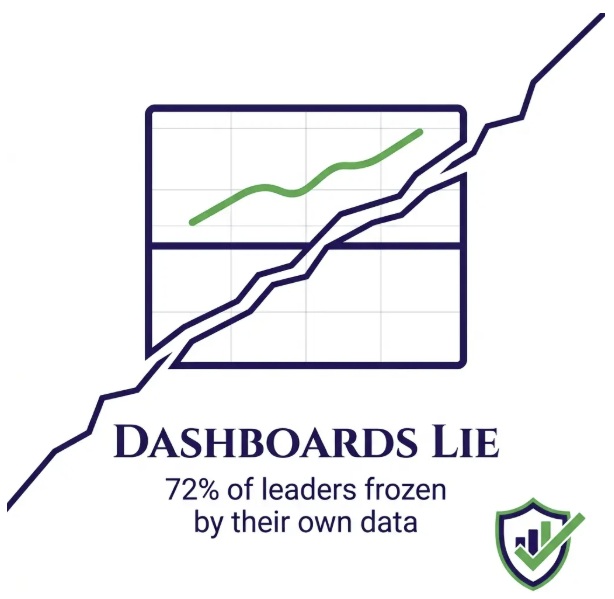
Oracle's 2023 Decision Dilemma study surveyed over 14,000 business leaders across 17 countries. The findings are stark: 72% of business leaders admit the sheer volume of data has stopped them from making any decision at all. Not slowed them down. Stopped them completely.
The problem is not the dashboard. The problem is that people give their own interpretation to the numbers without understanding the processes behind them.
When you look at a profit number, you see success. You do not see where that profit came from. You do not see when you actually achieved it. You do not see the cash flow timing that determines whether you can pay your bills next month.
A profit number is a picture. You need to see the movie.
How Dashboard Dependency Changes Behavior
Something shifts in an owner's behavior when they start trusting dashboard numbers instead of understanding the business underneath.
They become more reckless in decisions. They stop listening to experts because their feeling is always right. The dashboard becomes confirmation bias in visual form. It reinforces gut instinct rather than challenging it.
This is exactly what put my client in trouble in the first place. They were looking at input from a bookkeeper with no credentials. They did not understand the long-term impact of their decisions. They became lazy as the money rolled in, never realizing they were operating on thin margins.
Research shows that leaders who experience information overload are 7.4 times more likely to regret their decisions and 2.6 times more likely to avoid making decisions altogether.
The dashboard creates the illusion of control. You have visibility. You have real-time updates. You have colorful charts. What you do not have is understanding.
The Difference Between Numbers and Drivers
Most dashboards show revenue and profit. That is not enough.
A profit number does not tell you where it came from or when you achieved it. A profit driver tells the story of what you can adjust to make more money.
Take marketing expenses. If you look at marketing as just a cost line on your P&L, you miss crucial insights into your cost structure and why you are spending money on certain things. You need to see marketing expenses as a driver, not just a cost.
When I show owners the link between their marketing spend and actual revenue results, past and future, something changes. They start to see connections they never noticed before.
But it takes time. Usually a couple of months of working through specific topics before they realize everything is connected. Before they understand that you have to think further along the line about the impact of spending or cutting costs.
McKinsey research shows that only 20% of respondents felt their organizations excelled at decision-making. For a Fortune 500 company, poor decision practices can equate to over 530,000 employee days lost per year. That is an estimated $250 million in labor cost squandered.
You cannot afford to make decisions based on pictures when you need to see the movie.
What Your Dashboard Cannot Show You
Dashboards are structurally biased toward what can be measured.
They show you revenue, costs, margins, and cash position. They do not show you customer sentiment shifts, team morale erosion, market positioning decay, or strategic drift.
Your dashboard may show that you are hitting your numbers. It will not show the health of your employees. The people who make your company run may feel increasingly alienated, uninspired, and mistrustful as they work to hit their numbers. These are intangibles that do not appear on dashboards but profoundly impact your business.
Harvard Business Review research identified a phenomenon called "surrogation." Employees mentally replace abstract strategy with hard metrics meant to assess it. Because strategy is abstract, this tendency destroys significant value. People optimize for the measure rather than the underlying goal.
Campbell's law states that the more important a metric is in social decision-making, the more likely it is to be manipulated. When a single metric determines success or failure, people optimize their behavior to improve that metric. Sometimes with ridiculous or dangerous consequences.
People manage the metric rather than using the metric to help manage the underlying issue.
The Hidden Cost of Real-Time Data
Real-time dashboards promise immediate insight. What they actually deliver is decision paralysis.
When you can check your numbers anytime, you check them all the time. You watch fluctuations that mean nothing. You react to noise instead of signal. You mistake activity for progress.
Organizations lose an average of $15,000 per employee annually to decreased productivity when teams struggle with information overload. Employees now spend more than half their week just receiving and managing information rather than actually using it to do their jobs.
Jeff Bezos famously stated that most decisions should probably be made with around 70% of the information you wish you had. If you wait for 90%, in most cases, you are probably being slow.
Yet analysis paralysis keeps leaders seeking one more data point, creating the illusion that 100% certainty is attainable when it never is.
Direction beats precision. Always.
The Picture Versus the Movie
When business owners make decisions based on the picture instead of the movie, they make the same expensive mistake repeatedly.
They do not see the impact of the decision because they do not see what is next or what the impact will be on other parts of their financials. Cash flow. Gross profit margins. Net profit margins.
A dashboard is a snapshot. It shows you where you are right now. It does not show you where you are going or how you got here.
I look for leverage points when I work with clients. Maximum gain, minimum effort. I run what-if scenarios on current and future numbers to see where the biggest gains can be achieved with the least investment.
This is fundamentally different from what their dashboard tells them to focus on.
Their dashboard shows them what happened. I show them what is coming and what they can do about it.
Building Sight Lines Instead of Scorecards
You do not need more metrics. You need better questions.
The right question changes behavior faster than the right answer. Your dashboard will never ask you the questions that drive transformation.
It will not ask why your marketing spend is disconnected from your revenue results. It will not ask why your profit margins are shrinking even as revenue grows. It will not ask what happens to your cash flow if you make that expansion decision.
These are the questions that matter. These are the questions that create sight lines into your future instead of scorecards of your past.
I work with business owners to focus on certain topics, not all the metrics. Small steps make a big change over time as long as you stay focused on what actually moves the business forward.
HashiCorp eliminated 80% of its existing dashboards, retaining only those that delivered meaningful insights tied directly to business goals. The result was faster decision-making and reduced confusion.
Most dashboards are rarely revisited after being created. They turn into digital clutter.
What Actually Works
You need three things: revenue drivers, profit drivers, and cash flow drivers.
This combination gives you the full picture of the health of your business. Not just where you are, but where you are going and what you can do to change direction if needed.
Qualitative methods help you gain deeper understanding of the human and social aspects of your organization. Employee morale. Customer satisfaction. Market perceptions. Qualitative research explains why things are happening. Quantitative data only shows what is happening.
Effective decisions require understanding both.
If they do not understand it, it does not exist. Clarity is the only currency that compounds in business. Your dashboard can show you a thousand data points, but if you do not understand what they mean or how they connect, you are making decisions in the dark.
Direction beats precision. You do not need perfect models. You need confidence in the next move.
Stop staring at your dashboard. Start asking better questions. The answers you need are not in the numbers you are tracking. They are in the patterns you are missing.