
Why Tracking Everything Means Seeing Nothing
I watched a business owner pull up his dashboard last month. Forty-seven metrics. Color-coded. Updated in real time.
He couldn't tell me if he was making money.
This happens more than you'd think. Smart people, profitable businesses, completely paralyzed by their own measurement systems. They've built the perfect trap: so much information that nothing means anything anymore.
The data isn't the problem. The belief that more data equals better decisions is.
The Dashboard Illusion
Here's what nobody tells you about comprehensive dashboards: they answer questions you're not actually asking.
You built that forty-metric monster because someone convinced you that visibility equals control. Track everything, miss nothing, make better decisions. Except that's not how human cognition works.
Research from Oracle surveyed over 14,000 business leaders across 17 countries and found something startling: 72% of business leaders admit the sheer volume of data has stopped them from making any decision at all. Not slowed them down. Stopped them completely.
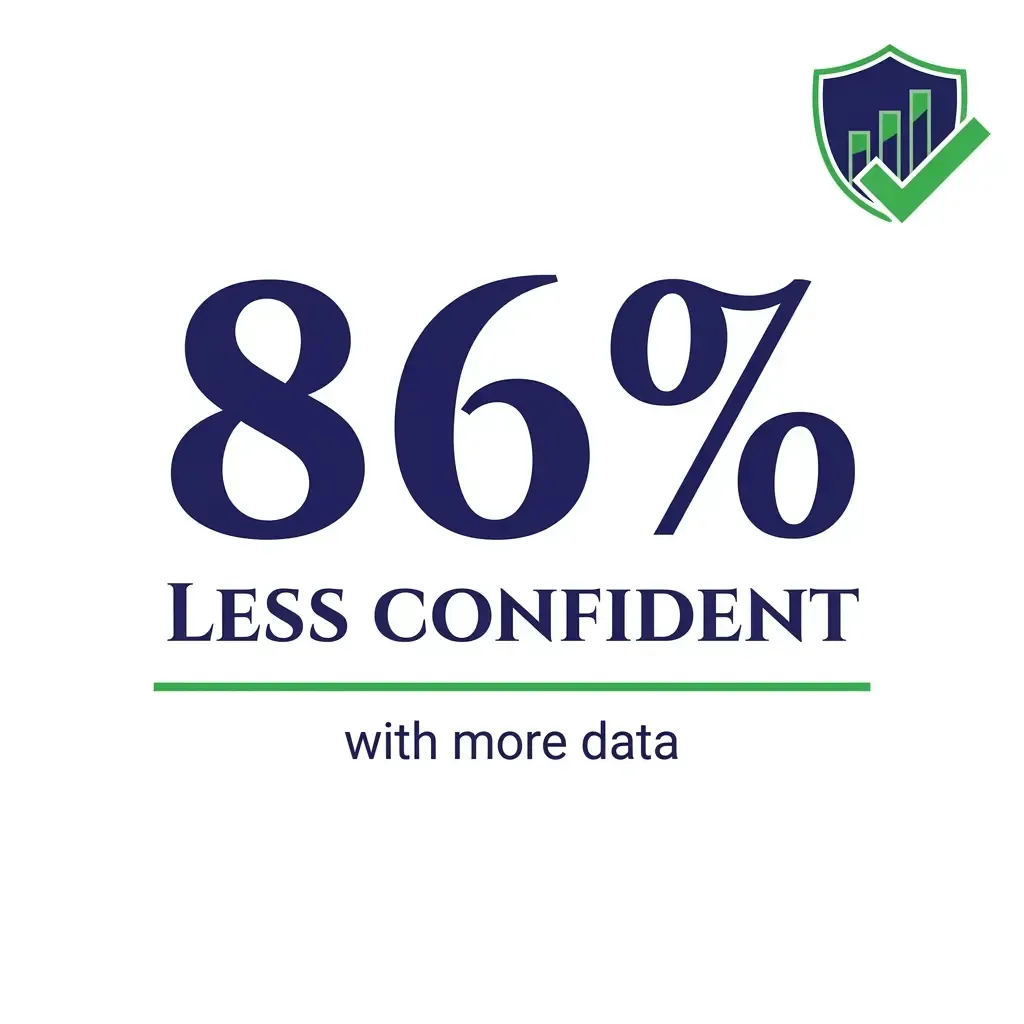
Even more revealing: 86% say data makes them feel less confident in their decisions.
Think about that. The tool you built to create certainty is generating doubt.
I see this pattern constantly in my work as a fractional CFO. Business owners who can recite twenty different conversion rates but can't explain why their bank balance dropped last month. People tracking gross margin, net margin, EBITDA margin, contribution margin, and still wondering why they're not hitting profit targets.
The dashboard isn't helping. It's performing.
What Metric Overload Actually Costs You
You're paying for all that measurement in ways you haven't calculated.
First, there's the obvious cost: time. Someone has to feed those dashboards. Pull the data, clean it, update it, verify it. That's hours every week that could go toward actually moving the business forward.
But the real cost is cognitive.
Your working memory can process five to nine elements simultaneously. When your dashboard exceeds 12 KPIs, engagement rates drop 40% because users experience cognitive overload. You're not making better decisions with more metrics. You're making slower ones, or none at all.
I bring my own dashboard when I work with clients. It's built around their strategy and objectives, not industry standards or accounting conventions. I compare their actuals to forecasts, run what-if scenarios, and identify the three drivers that will make the biggest impact on their targets.
Three drivers. Not thirty.
The reaction is usually the same: relief mixed with surprise. They knew something was driving results, but seeing it isolated from the noise creates clarity they haven't felt in months.
That clarity doesn't come from better dashboards. It comes from ruthlessly eliminating everything that doesn't change behavior.
The Measurement Trap You Don't See
Here's the pattern I've noticed: tracking becomes avoidance.
When you're uncertain about the next move, adding another metric feels productive. You're doing something. Gathering information. Being thorough.
But you're not moving forward. You're constructing elaborate justifications for staying still.
The number of decisions people make every day has increased 10x over the last three years. Rather than empowering better choices, unlimited access to information often leads to greater fear of making the wrong decision.
I ask clients one question when they bring up a new metric they want to track: What do you actually want to achieve?
Not what does the industry track. Not what your accountant recommends. What are you personally trying to accomplish, and does this number get you closer to that goal?
Most of the time, there's no connection. The metric is theater. It looks professional, sounds important, and contributes nothing to the outcome they're chasing.
When someone realizes a metric they've been obsessing over has zero link to their actual goals, something shifts. The irrelevant stuff falls away naturally. They stop defending measurements that don't earn their attention.
How to Identify What Actually Matters
You need a filter. Something that separates signal from noise before the noise buries you.
I use a simple test: If you can't act on a metric this week, why are you measuring it?
Lagging indicators report history. They tell you what happened, which is useful for learning but useless for steering. Leading indicators shape the future. They show you where you're headed in time to adjust course.
Most dashboards are 80% lagging, 20% leading. Then people wonder why they feel like they're driving by looking in the rearview mirror.
When I build financial models for clients, I focus on drivers: profit drivers like gross margin and net margin, revenue drivers, cash flow drivers. Everything else they want to measure usually fits into these categories. It's redundant.
Two areas consistently unlock breakthroughs for owners stuck in data overload:
Margin structure. Business owners often don't know how their margin is actually built. They track the final number but can't explain the components. When you show them how small changes in pricing or cost structure compound through the system, they see leverage they didn't know existed.
Cash flow mechanics. Specifically, payment terms. Most people who want to do well pay their suppliers immediately. They think it's the right thing to do. But paying within agreed terms instead of rushing keeps more cash working in the business.
When I show clients the direct impact in my financial model—exactly when they'll hit a pain point versus smooth sailing—the emotional attachment to immediate payment dissolves. They see it's not about being unfair. It's about using the terms both parties agreed to.
There's always hesitation at first. You want to do the right thing. But when next month's prediction becomes reality, trust in the model grows. They start leaning into the numbers instead of their gut reactions.
The Discipline of Ignoring
Strategic plans with fewer than 20 total elements—goals, measures, and projects combined—succeed 68% of the time. The median strategic plan in 2026 includes just nine key performance indicators.
Less isn't a compromise. It's the structure that creates results.
But knowing you should focus on fewer metrics and actually doing it are different problems. The urge to measure everything returns. It feels safer. More thorough. Like you're covering all the bases.
This is where rhythm matters.
I meet with clients monthly. Same cadence, same structure. We review the three drivers, compare actuals to targets, and identify what needs to adjust. The consistency creates momentum.
Every success I've seen comes from doing the right things on a regular basis. Not perfectly. Not comprehensively. Consistently.
When someone starts drifting back into the noise—bringing up metrics that aren't part of the three drivers, asking about data that doesn't connect to their targets—I bring them back to their personal goals. Their business goals.
If there's no link between the metric and the goal, they make the conclusion themselves. The question they're trying to answer isn't adding to the result they're after.
Some people explore anyway. They get sidetracked. It becomes difficult to return to the core activity, to what they actually want to achieve. That's when you're performing triage: investigate, then decide. Do we integrate this into the overall goals, abandon it completely, or park it for later?
Anything that stays in limbo keeps pulling attention away from real work.
When the System Becomes the Business
The biggest mindset shift I see separates business owners who break through from those who stay stuck in complexity.
It happens when they start trusting the system.
You learn how to tweak the drivers. You see that adjusting payment terms improves cash flow, that pricing changes flow through to margin, that focusing on three metrics instead of forty creates faster decisions and better outcomes.
That's when you stop being the system and start having one that works for you.
You're not in it anymore yourself. You've built a machine you can tweak and maintain. That's the change from owning a job to owning a business that adds value independent of your constant presence.
This is where scaling becomes possible. Not because you're working harder or tracking more, but because you've built sight lines into what actually drives results.
You know which three numbers to watch. You know what happens when each one moves. You can predict next month with enough accuracy to make decisions this week.
That's not complexity. That's clarity.
What to Do Next
Look at your current dashboard. Count the metrics you're tracking.
Now ask yourself: which three would you keep if you could only choose three?
Not which three your industry says matter. Not which three your accountant tracks. Which three actually change your behavior and drive you toward the goals you've set?
If you can't answer that question clearly, you're measuring the wrong things.
Start with fundamentals: one profit driver, one revenue driver, one cash flow driver. Build your model around those. Run what-if scenarios. See what moves the needle.
Then commit to reviewing those three metrics monthly. Same rhythm, same structure. Track whether your predictions match reality. Adjust when they don't.
The discipline isn't in tracking everything. It's in ignoring most things so you can see the few that matter.
That's how you turn data fog into financial command.