Your Bank Balance Is Not a Cash Forecast
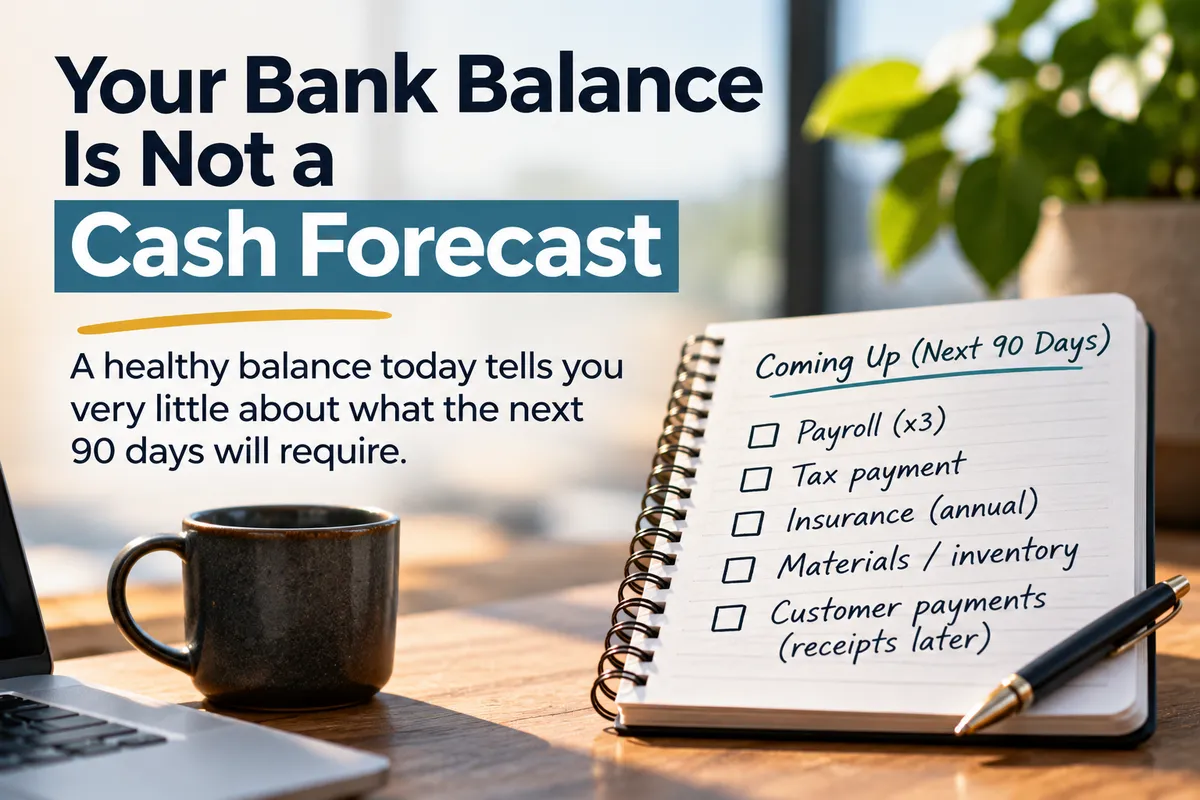
A healthy balance today tells you very little about what the next 90 days will require from your business.
If you’re making decisions based primarily on how much cash is in the bank today, you may be missing what’s already coming. Book a Right-Fit Call to talk about building a more forward-looking view of your business.
There is something reassuring about a healthy bank balance. When there is plenty of cash available, approving a new hire, purchasing equipment, taking an owner distribution or making another investment in the business can feel like an easy decision.
The problem is that the money sitting in the bank today already has a future.
Some of it will become payroll. Some will pay taxes, suppliers, insurance, debt or rent. Some may be needed to purchase inventory or materials before the company gets paid by its customers. And some needs to remain available simply because businesses rarely operate exactly according to plan.
That is why looking at the bank balance can tell you how much cash you have, but it can't tell you how much cash you can safely spend.
A strong month can create false confidence
Consider a composite example of an established company that finishes the month with $400,000 in the bank. Sales have been strong, receivables look healthy and there are several large projects underway. From the owner's perspective, the company appears to be in a comfortable position.
Over the next six weeks, however, the business has three payrolls to fund, a significant tax payment coming due, an annual insurance payment and materials to purchase for upcoming work. Two large customer invoices are outstanding, but the company doesn't expect to collect them until later in the quarter.
Nothing has necessarily gone wrong. The company may still be profitable and having a very good year. But the $400,000 that looked comfortably available at the end of the month was never really $400,000 of discretionary cash.
That distinction becomes particularly important when owners are making decisions that create additional commitments. Hiring another employee doesn't just affect this month's payroll. Purchasing equipment can create financing obligations. Taking a large distribution may be completely reasonable, but only if the company can comfortably fund what happens afterward.
The question isn't simply, "Can we afford this today?" It's also, "What else does this money need to do?"
Timing changes the meaning of cash
Two businesses can produce the same annual profit and have completely different experiences with cash.
One might collect deposits before beginning work and receive the remainder quickly after completion. Another might pay labour and materials for weeks before invoicing a customer, then wait another 30, 60 or 90 days to collect.
The income statements could eventually tell a similar story. The amount of cash each business needs to operate along the way could be very different.
Growth can make this even more noticeable. More sales often require more spending before the corresponding cash arrives. A company may need additional people, inventory, materials or production capacity to support work that won't turn into collected cash for weeks or months.
That is one reason an owner can look at a strong sales pipeline and wonder why the business still feels tight. The sales may be real. The profit may eventually be real. But neither pays Friday's payroll until the cash actually arrives.
The goal isn't necessarily a bigger cash reserve
When businesses repeatedly encounter cash pressure, the obvious answer can seem to be keeping more money in the bank. Sometimes that is exactly what is needed. A stronger reserve can make a company much more resilient.
But simply accumulating more cash doesn't address the entire problem if the owner still doesn't know what's coming.
A company with $1 million in the bank can make a poor decision if it assumes that money is available without considering future commitments. A company with much less can make sound decisions if it understands its expected inflows, obligations and potential pressure points.
The objective isn't to predict every dollar perfectly. Businesses don't work that way. Customers pay late, projects move, unexpected expenses appear and opportunities arise that weren't in the plan.
The objective is to reduce unnecessary surprises.
If you can see that cash is likely to become tight two or three months from now, you have options. You can adjust the timing of a purchase, accelerate collections, reconsider a distribution, arrange financing before you urgently need it or simply decide that the temporary pressure is acceptable.
Those same decisions become much harder when the bank account is already approaching an uncomfortable number.
Good decisions require a view beyond today
Owners make decisions constantly about where company money should go. Some of those decisions are defensive, while others are investments intended to make the business better. The challenge is that every dollar can only be allocated once.
A healthy bank balance can create confidence, but confidence should come from understanding what the business can support rather than simply seeing a large number on the screen.
This becomes increasingly important as a company gets larger. The numbers grow, the commitments get bigger and the consequences of timing become more significant. A decision that barely registered in a smaller company can represent hundreds of thousands of dollars once the business reaches another level.
The bank balance still matters. It just needs context.
A useful question isn't only, "How much cash do we have?" It is, "What does our cash need to do next?"
And perhaps the more useful question for an owner is this: If you knew what your cash position was likely to look like 90 days from now, would you make the same decisions you're making today?
If you want a more forward-looking view of what your business can comfortably support, book a Right-Fit Call. We can talk about where the business stands today and what the months ahead may require from it.